 GymRhythm
Here's the short answer. If you still want to log sets and reps, the best Hevy alternative is simply another rep logger, and Strong, Jefit, and Boostcamp are the honest names to look at first. But if Hevy is your second or third abandoned workout logger, the problem probably isn't the app. It's logging itself, and the fix is a tracker that asks you to type nothing at all.
This guide covers both paths. Real logger recommendations first, then the option almost nobody mentions.
Why people leave Hevy and Strong
Hevy and Strong are both good apps. That's worth saying up front, because most "alternative" articles pretend otherwise. People leave them for a handful of specific reasons, and knowing yours tells you exactly what to switch to.
- Subscription fatigue. Strong has moved toward a subscription model, and users who remember it as a cheap one-time purchase feel burned. Hevy's paid tier is optional, but every logger nudges you toward paying eventually.
- Logging friction. Every set means pulling out your phone, tapping through screens, and typing numbers between lifts. Some people find that grounding. Others find it kills the flow of a workout.
- Wrong feature mix. Hevy's social side feels noisy to lifters who just want a notebook. Strong feels bare to lifters who want ready-made programs and coaching.
- You simply stopped opening it. The app was fine. The gym visits continued. The logging didn't. This one matters most, and it gets its own section below.
Figure out which of these is yours before installing anything, because the fixes point in very different directions.
If you still want to log: honest Hevy and Strong alternatives
If you like reviewing your numbers and the app itself was the problem, switch loggers and keep the habit. Both Hevy and Strong can export your training history, so you're not starting from zero.
Match the alternative to your reason for leaving:
| Why you're leaving | Better fit |
|---|---|
| Strong's subscription pushed you out | Hevy. Its free plan covers everyday logging, and it's the most direct Strong alternative. |
| Hevy's social side isn't for you | Strong, or a minimalist logger like Setgraph that's closer to a plain digital notebook. |
| You want programs, not blank templates | Boostcamp. It pairs a logger with programs written by well-known coaches. |
| You want the app to suggest your next weight | Alpha Progression, which is built around progression recommendations. |
| You want free forever, no surprises | Apple Notes or a spreadsheet. Unfashionable and unbreakable. |
| You keep abandoning loggers | No logger. Keep reading. |
One honest note about switching: a new logger feels great for the first two or three weeks because novelty is doing the heavy lifting. If your last app died from neglect rather than a genuine shortcoming, expect the same arc with the next one.
Free options since Strong went subscription
Strong's shift to subscription pricing sent a lot of long-time users hunting for free options. Here's the honest landscape.
- Hevy's free plan is the usual landing spot. It handles day-to-day logging, with a paid upgrade for extras. Free tiers change, so check the current limits before migrating years of history.
- Jefit offers a free, ad-supported version and one of the biggest exercise databases around. The interface is busier than Strong's ever was.
- Boostcamp makes its core logger and a library of coach-written programs free to use, which is a strong deal if you want structure.
- Notes or a spreadsheet cost nothing and will never change their pricing. You lose graphs and rest timers, but plenty of very strong people trained for decades on paper.
Whatever you pick, export your data on the way in and again every few months. The lesson of Strong's pricing change is that any app's free tier is a policy, not a promise.
The pattern: your third abandoned logger isn't a coincidence
Now the part most alternative roundups skip.
If you've cycled through Strong, then Hevy, then maybe Jefit or a spreadsheet, and each one died the same slow death, look at the shape of the failure. It's almost always this: you log everything for three motivated weeks. Then a busy week hits. You still train, but you skip logging one session because you're rushed. The record now has a hole in it, the perfectionist part of your brain declares it ruined, and the app quietly slides off your home screen. The gym continues. The data stops.
Research on habit formation suggests that habits survive when the required action is small and the friction is low. A rep logger adds a nontrivial task to every single set of every single workout. For people who genuinely enjoy the numbers, that cost is fine, even pleasant. For everyone else it's a tax, and taxes get evaded.
Here's the reframe: you were never failing at training. You were failing at data entry. Those are different problems. If consistency is what you actually care about, there's a whole system built around it, which we cover in how to be consistent with the gym.
The alternative to logging: track attendance instead
Strip training progress down and one metric predicts almost everything over the years: did you keep showing up. Program details matter, but no program survives you not being at the gym. Attendance tracking records the visit and deliberately ignores the contents.
You can do this manually. A paper calendar with an X for every gym day works, and a general habit tracker app works too. We compared those approaches in our guide to the best gym habit tracker apps. But manual check-ins inherit the same weakness as rep logging, just in a smaller dose: you still have to remember to do them.
The fully automatic version uses your iPhone's geofencing, and it's what I built GymRhythm around. You pin your gym on a map once and set a radius. From then on, every visit logs itself with your arrival time and duration. Multiple gyms are supported, so a second location or a vacation gym still counts. On top of that sit the things that make consistency visible: streaks, a weekly goal measured in gym days per week, a GitHub-style heatmap of your whole year, your average session time, and routine insights that show which days you actually train. There's also a 50-level XP system where leveling up unlocks real features like advanced analytics and dark mode.
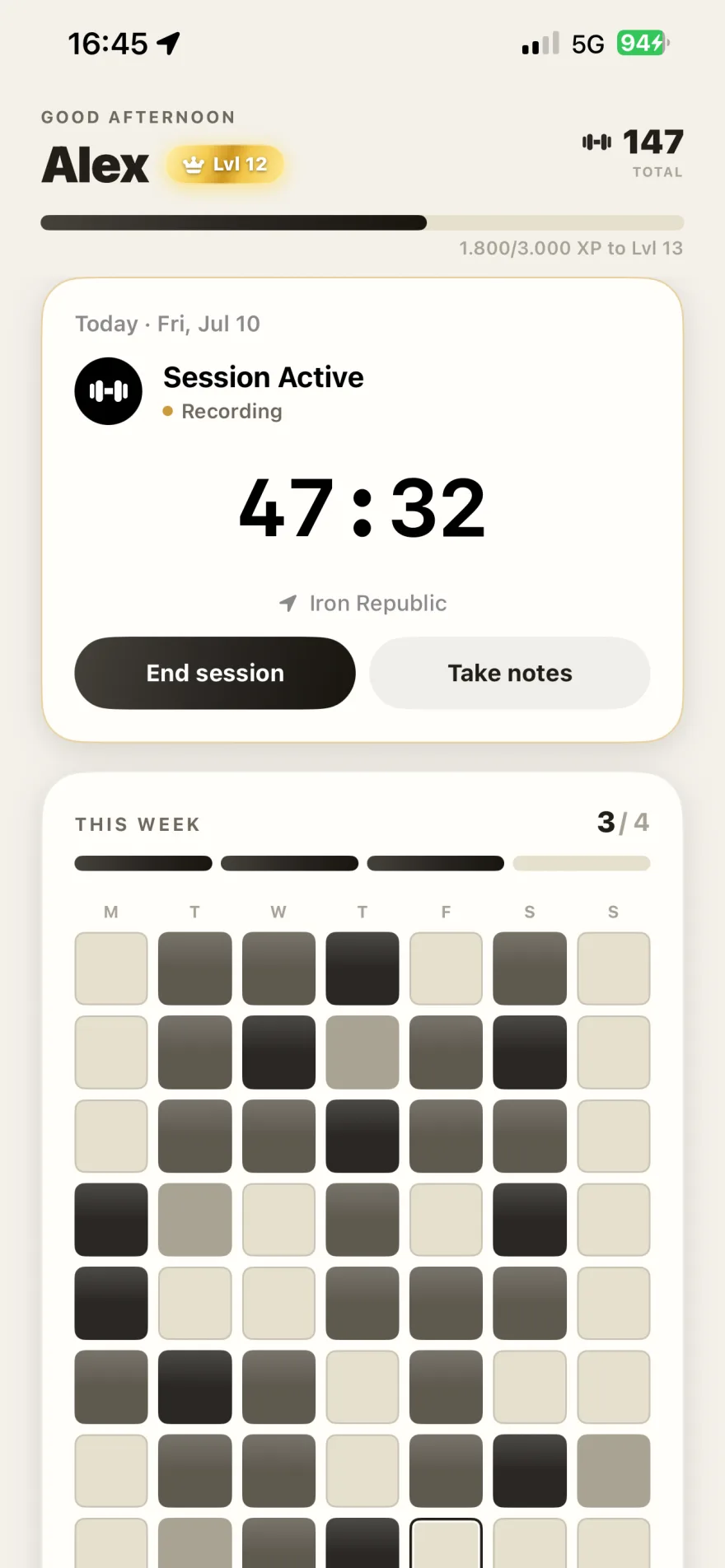
To be equally honest about GymRhythm: it keeps no set, rep, or PR history at all, on purpose. It won't tell you what you benched in March. It will tell you exactly how many days you showed up this year and whether you ever went dark for two weeks. It's iPhone-only and free to download, with a premium subscription for full access. If you want to compare automatic visit counting with other approaches first, the guide to apps that track gym visits goes deeper.
What you give up (and what you finally keep)
Switching from a rep logger to attendance tracking is a real trade, so here it is plainly.
You give up: per-exercise history, progression graphs, plate math, rest timers, and PR celebrations. If you run a strict progressive overload program and reviewing last week's numbers is how you load the bar, keep a rep logger. Hevy or Strong is the right tool for that job, and no attendance tracker replaces it. You can also run both, since tracking visits doesn't conflict with logging lifts.
You finally keep: a complete, honest record. Every visit counts, including the rushed ones, the deload days, and the sessions during your worst week of the year. Your streak no longer depends on your discipline to log. And at the end of the year you get one picture of everything you did, which is its own kind of motivating. If that green-squares idea appeals to you, see our guide to GitHub-style fitness trackers.
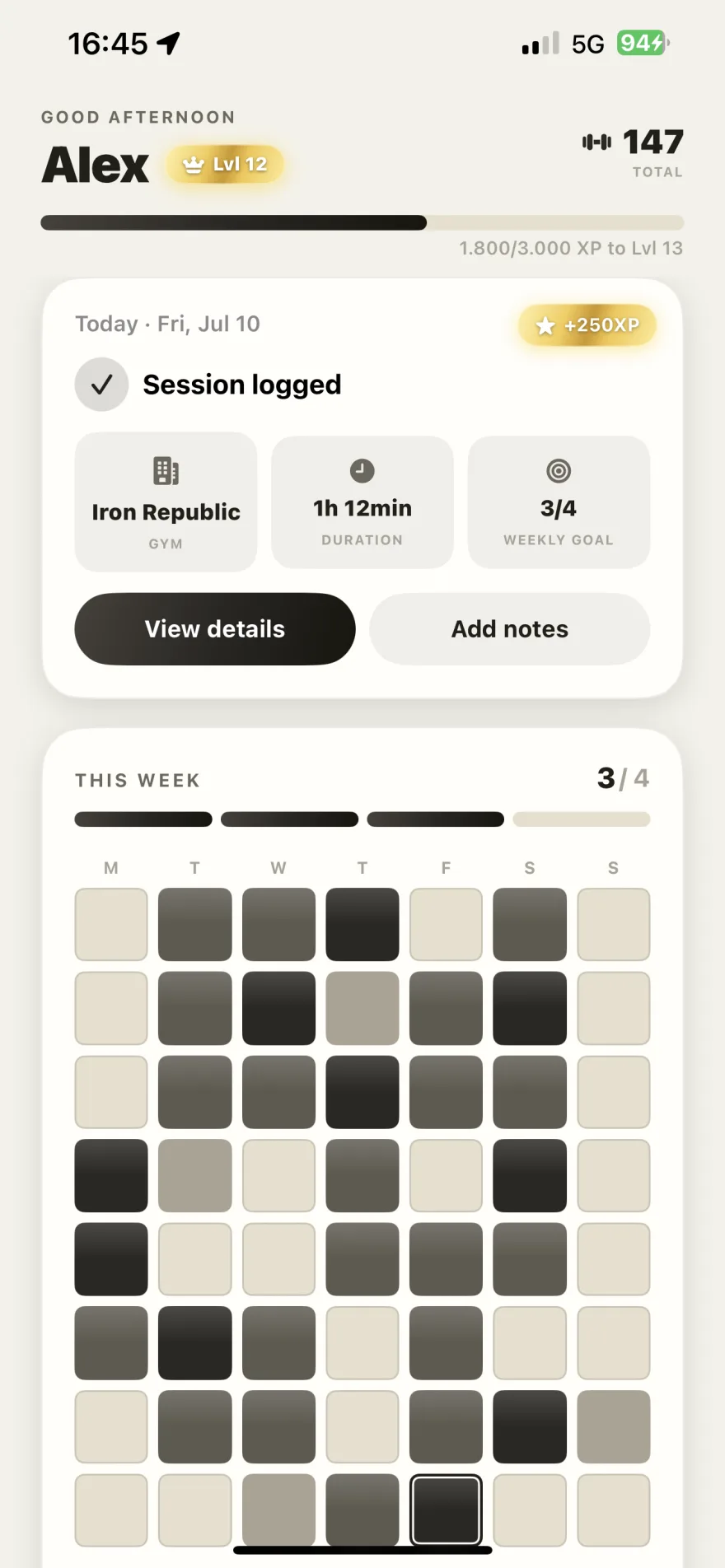
So, do you need another logger? If you love the numbers, yes, and Hevy, Strong, Jefit, or Boostcamp will serve you well. But if you've already abandoned three of them, the best Hevy alternative for you probably isn't a logger at all. It's something that notices you walked through the gym door and handles the rest.