 GymRhythm
Here's the short answer. People who stay consistent with the gym don't rely on motivation at all. They train on fixed days at fixed times, they allow themselves short sessions when energy is low, they never miss two planned days in a row, and they track attendance instead of performance. This guide unpacks how to be consistent with the gym using those four moves, and why they work when "just be more disciplined" never does.
Motivation vs. consistency: why willpower loses
Motivation is an emotion. It moves with your sleep, your stress, the weather, and how your week is going. In week one it's easy to find. By week three the novelty is gone, results haven't arrived yet, and the same brain that signed you up starts producing excellent reasons to stay home.
Consistent gym-goers aren't immune to any of that. They've just stopped putting motivation in charge. Research on habit formation suggests a new behavior takes around two months on average to start feeling automatic, and for many people it takes considerably longer. That leaves a long stretch where the excitement is gone but the habit hasn't formed yet. Willpower can't cover a gap that size. A system can, because a system keeps making the decision for you on the days you'd decide wrong.
The difference shows up in small, boring moments:
| Moment | Motivation-driven | System-driven |
|---|---|---|
| Monday morning | "I'll see how I feel after work" | Gym is at 6pm. It's in the calendar |
| Low-energy day | Skip, promise to make it up later | Show up for a 20-minute minimum session |
| After a missed day | Guilt, then "I'll restart on Monday" | Never miss twice. Next session happens as planned |
| Measuring progress | Mirror and scale, daily | Days trained this week, nothing else |
Notice that none of the system-driven answers require feeling good. That's the entire point.
Treat gym days like appointments
The most reliable people in your gym decided once, months ago, and haven't decided since. Monday, Wednesday, Friday at 6pm, or whatever fits their life. The question "am I going today?" doesn't exist for them, and that question is exactly where consistency dies. Every time you reopen it, you give tired-you a vote.
So make it an appointment. Same days, same time slot, in your actual calendar, treated with the same weight as a dentist visit or a meeting with your boss. You wouldn't skip those because you didn't feel like it.
Two rules make the schedule hold:
- Pick a frequency you can hit on your worst week, not your best. Three days is enough for real progress for most people, and it's far easier to defend than five. If you're unsure, read our guide on whether going to the gym 3 times a week is enough. Short version: it is.
- Anchor sessions to things that already happen. Straight after work, before your evening shower, right after the school run. A session glued to an existing routine needs no reminder and no decision.
Shrink the session until you can't say no
Here's the deal consistent people make with themselves: attendance is non-negotiable, effort is flexible. On a bad day you still go, but you're allowed to do twenty minutes and leave. That session counts. Fully.
This works because the hard part of the gym is the door, not the workout. Once you're inside, warm and moving, the "I don't have the energy" story usually collapses on its own, and the twenty-minute session turns into a normal one. And when it doesn't, you still went. The habit loop fired, the schedule held, and the next session got easier instead of harder.
Shrinking the session is not lowering your standards. It's pointing your standards at the right target. A mediocre workout you did beats a perfect workout you skipped every single time, because the skipped one costs more than a day of training. It costs you the pattern.
The never-miss-twice rule
You will miss sessions. You'll get sick, work will explode, life will happen. Consistent people don't actually miss much less than you do. They recover faster.
The rule is simple: one miss is an accident, two misses in a row is the start of a new habit. So a missed session triggers exactly one action, which is confirming the next one. Not doubling the next workout, not guilt, not "I'll restart fresh on Monday". Monday restarts are how a missed Tuesday becomes a lost week.
Physically, a single miss costs you almost nothing. Most evidence on detraining suggests it takes roughly three to four weeks of complete inactivity before strength meaningfully declines. We break that timeline down in what actually happens when you skip the gym for a week. The danger of a missed day was never your muscles. It's the story you tell yourself about it. Never miss twice replaces the story with a procedure.
Track attendance, not performance
If you track only one thing in your first year, track the days you showed up. Not weight lifted, not body weight, not calories. Attendance is the one number that's fully under your control, always moves the right way when you act, and predicts everything else. Performance numbers stall and fluctuate even when you're doing everything right, and a stalling number is quietly demotivating at the exact moment you need the opposite.
There's a catch, and it's the step where most people have already failed once before: tracking is itself a habit. A paper calendar, a spreadsheet, a manual check-in app. All of them depend on you remembering to log, and the logging dies in week three right alongside the motivation. Then the record looks broken, so the streak feels broken, so you stop going. The tracker that was supposed to protect the habit ends up killing it.
Two honest notes before the fix. If what you actually want to record is sets, reps, and PRs, an attendance tracker is the wrong tool, and you should use a proper logger like Hevy or Strong. Our breakdown of Hevy and Strong alternatives covers who needs which. And if you want the full landscape of manual and automatic options, our guide to gym habit tracker apps compares them properly.
For pure attendance, though, the fix is to remove yourself from the loop entirely. That's exactly what GymRhythm was built for. You pin your gym on a map once, set a radius, and Apple's geofencing does the rest. Every visit gets detected and logged automatically with arrival time and duration, so your streak and weekly goal keep counting even in the weeks you forget the app exists. Which, around week three, you will.
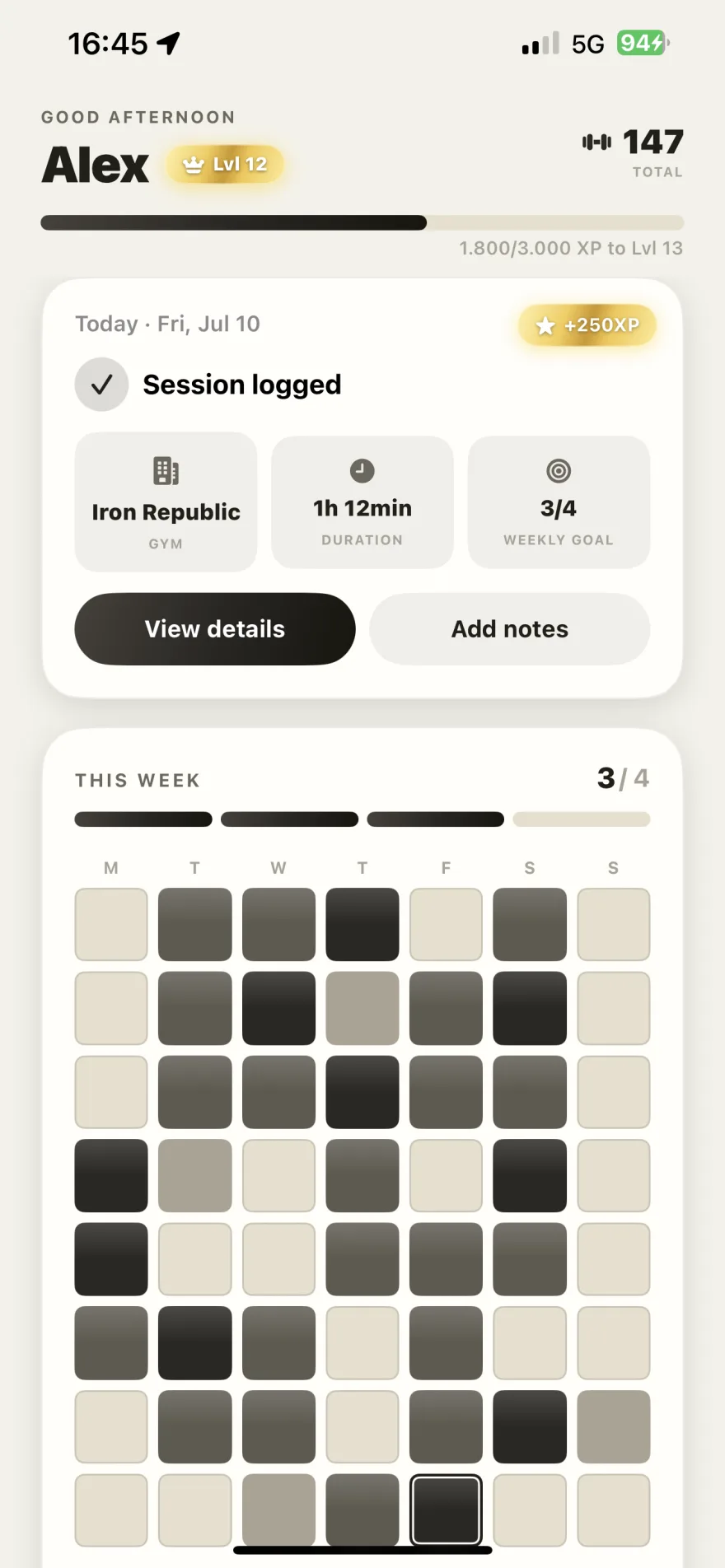
One detail matters more than it looks: set your weekly goal in gym days, not sessions or hours. "Three gym days this week" is binary and honest. You either went or you didn't, and a goal ring that fills by Thursday is a small, real win during the long stretch before physical results arrive.
Make progress visible before results show
Visible body changes typically take a couple of months. That gap between starting and seeing anything is where most gym attempts quietly die, because the brain wants evidence that the effort is doing something. Consistent people bridge the gap with proxy evidence. Not "do I look different yet?" but "is the pattern holding?"
The best format anyone has found for that is the contribution graph, the GitHub-style grid where every training day fills in a square. Developers have used it for years to stay consistent at coding, and it works for the gym for the same reason. A month of filled squares becomes something you don't want to break, and a year of them is proof no mirror can argue with. We wrote more about the format in our GitHub-style fitness tracker guide.
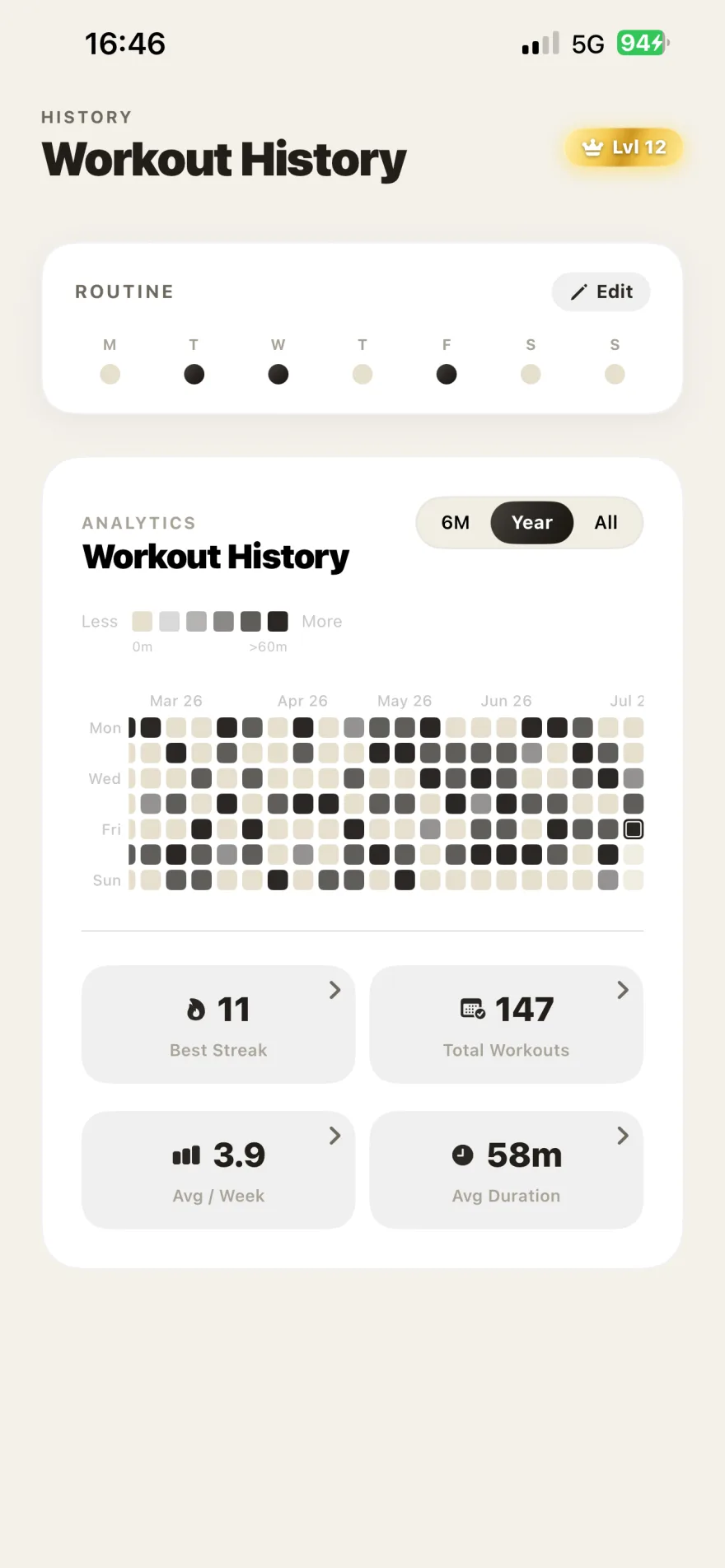
A streak, a filling weekly ring, a heatmap growing denser, a note showing which weekdays you actually train. None of it builds muscle. All of it keeps you showing up through the months where the muscle is quietly being built.
How to be consistent with the gym on zero-motivation days
Everything above gets stress-tested by the day you genuinely, deeply do not want to go. Here's the playbook for that day, in order:
- Don't renegotiate at decision time. The appointment was made by a smarter, better-rested version of you. Tired-you only gets to choose how, not whether.
- Invoke the minimum session. Twenty minutes, or even fifteen. Do only the exercises you like. A junk-food workout on a zero day is a strategic win, not a cheat.
- Make the first step stupidly small. Don't decide to work out. Decide to put on gym clothes. Then decide to head there. Each step makes the next one nearly automatic.
- Do the never-miss-twice math. If yesterday was already a miss, today isn't optional anymore. If it wasn't and you truly need the rest, take it, and lock in tomorrow before you sit down.
- Look at your record before deciding anything. A streak on the line and a weekly ring one day from full have talked more people through the gym door than any pre-workout ever has.
If your zero-motivation days aren't occasional but structural, because routines themselves are the hard part for your brain, the system needs extra scaffolding. We wrote a dedicated guide on gym consistency with ADHD for exactly that.
Notice what's missing from the playbook: getting motivated. Staying motivated was never the skill. How to be consistent with the gym comes down to four decisions you make once. Fixed appointments, a minimum session you can always clear, never missing twice, and an attendance record that keeps itself. Build the system on a good day, and it will carry you through the bad ones.