 GymRhythm
The average gym session length: 45 to 75 minutes for most gym-goers
The average gym session length lands between 45 and 75 minutes for most regular gym-goers, and a flat hour is the single most common answer people give. That range shows up consistently wherever the question gets asked, from gym owners talking about floor traffic to fitness apps summarizing their users, even if no two sources agree on the exact minute.
Before you compare yourself to that number, know what it actually describes. It usually means time spent inside the gym, not time spent training, and those two can differ by 20 minutes or more. It blends wildly different people, from the 25 minute treadmill visit to the two hour powerlifting session. And it's self-reported far more often than it's measured, which turns out to matter a lot. More on that below.
So here's the honest short answer. If your sessions run 45 to 75 minutes, you're squarely typical. If they don't, that's not automatically a problem, because the right length depends on what you're training for.
How session length varies by goal
The biggest driver of session length isn't discipline or fitness level. It's rest periods. Heavy strength work needs long breaks between sets, so those sessions stretch out even when the actual work is brief. Cardio is one continuous block, so those visits run shorter and more predictable. Here's how typical sessions break down by goal. Treat these as common ranges, not rules.
| Training goal | Typical session | What drives the time |
|---|---|---|
| Heavy strength work | 60 to 90 minutes | Long rests between heavy sets, often 2 to 4 minutes each |
| Muscle building | 45 to 75 minutes | More total sets with moderate rests |
| General fitness | 45 to 60 minutes | A mix of lifting and cardio with shorter rests |
| Steady-state cardio | 30 to 60 minutes | One continuous block, easy to plan around |
| Classes and HIIT | 30 to 45 minutes | The class schedule decides for you |
Two people can both be doing everything right and have averages 40 minutes apart. Someone doing three 30 minute conditioning sessions a week is not training worse than someone doing two 90 minute lifting days. That's why comparing your number to the population average is far less useful than comparing it to your own goal.
Door-to-door time vs. actual training time
When someone says they spent an hour at the gym, that hour usually includes changing shoes, filling a water bottle, waiting for a squat rack, saying hi to the front desk, and a few minutes of scrolling between sets. The actual training inside a 60 minute visit is often closer to 35 or 40 minutes, and that's completely normal.
Both numbers are worth knowing, but for different reasons:
- Door-to-door time is what your calendar feels. It decides whether the gym fits before work, whether a lunch break session is realistic, and how sustainable your routine actually is week after week.
- Training time is what your program cares about. It's the number a coach would ask for, and it determines whether you're getting enough quality work done per visit.
Most advice online talks about training time. Most real-life scheduling decisions run on door-to-door time. And when people quietly quit the gym, it's usually the door-to-door number that broke them, because a "one hour workout" that really costs 100 minutes with travel and showers is a very different commitment than it sounds.
Is longer better? What the evidence says
No, not by itself. The broad picture from exercise research is that results track your total weekly training, not the length of any single session. The widely used WHO guideline of at least 150 minutes of moderate activity per week deliberately says nothing about how you slice it. Research on resistance training points the same way, in that the total amount of quality work you do across a week matters far more than whether it arrives in three long sessions or five short ones.
There's a practical ceiling too. Long sessions carry costs that never show up in a program spreadsheet:
- Fatigue builds within a session, so the quality of your last exercises drops.
- Big time commitments are the first thing that gets cut in a busy week.
- Research on habit formation suggests that repeating an easy, consistent behavior beats occasional heroic efforts, so a session short enough to repeat wins long term.
If you can only spare 45 minutes three times a week, that's genuinely enough to make progress toward most goals. We break that exact question down in Is Going to the Gym 3 Times a Week Enough?, but the short version is that showing up regularly beats showing up long.
Why you're probably guessing your own number wrong
Here's the twist in this whole topic. The population average is easy to look up, but your own average is weirdly hard to know. Ask yourself right now how long your typical gym session is. Whatever you just answered is almost certainly a round number, probably 60 or 90, and probably off by a meaningful margin.
A few reasons why:
- We round to clean numbers. A 52 minute session gets remembered as "about an hour."
- We remember our best days. The focused 75 minute session sticks in memory. The rushed 30 minute visit before dinner quietly falls out of the mental average.
- We count the plan, not the reality. Your program says 60 minutes, so 60 becomes your answer, even in weeks where traffic and life shaved it down to 40.
The tools most people already own don't fix this. An Apple Watch times workouts you remember to start and stop, and one forgotten stop button inflates a whole week of data (we cover that gap in Does Apple Watch Track Gym Visits?). Lifting loggers like Hevy or Strong effectively time you from your first logged set to your last, which misses the warm-up and everything after, and only works on days you log everything. To be clear, if logging sets and weights is what you want, those are excellent apps, and we compare them honestly in Hevy & Strong Alternatives. But none of them answer the simple question of how long you're really at the gym.
How to measure your real average automatically
To know your true average, you need arrival and departure times for every visit over a few weeks, captured without you having to remember anything. There are a few ways to get there:
- Manual timing. Note your in and out times in a notes app or spreadsheet. Free and accurate, but it depends on you remembering twice per visit, and most people stop within a week.
- Your gym's check-in data. Some gyms show visit history in their member app. Worth checking, though many only record entry and not exit, so you get visit counts without durations.
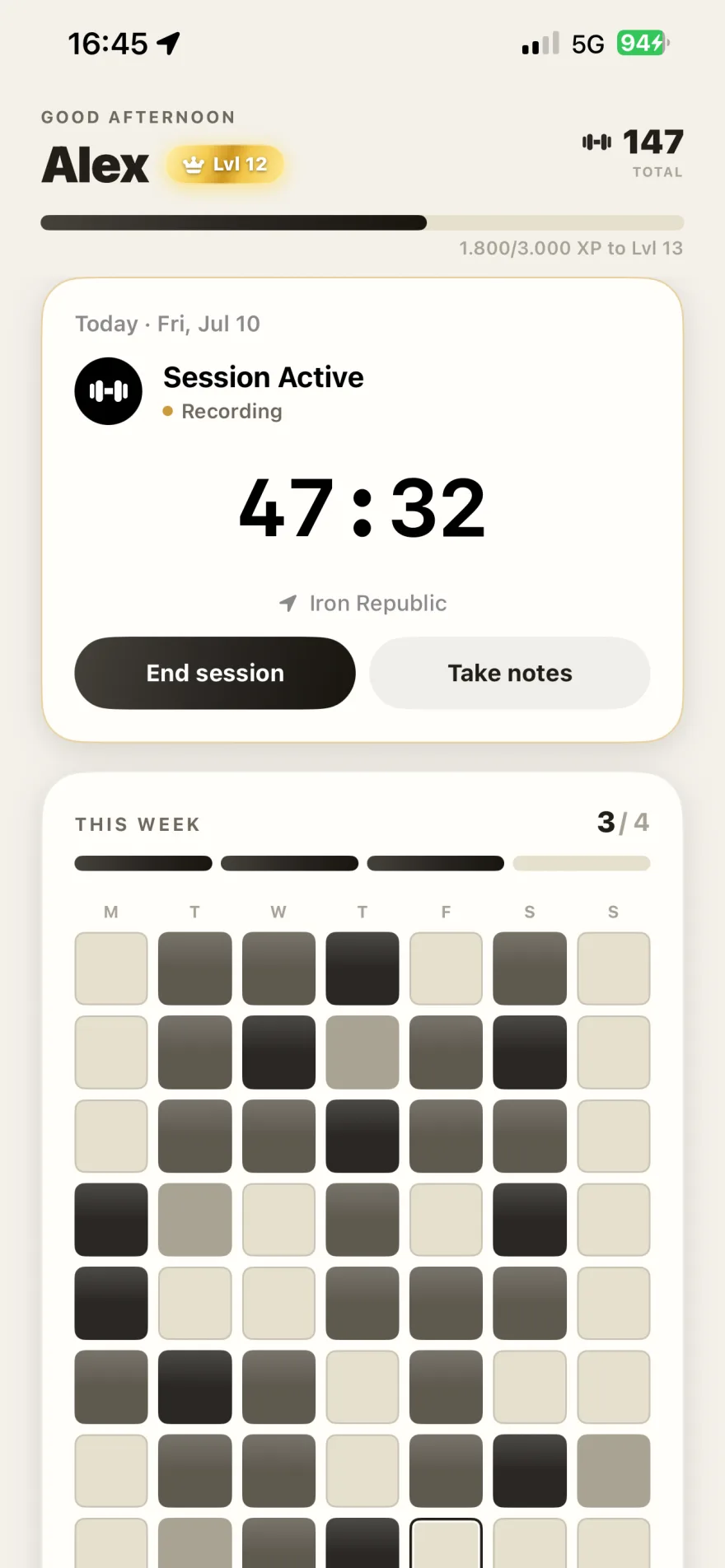
- Geofencing. Your iPhone already knows where you are. An app can watch a small radius around your gym and stamp the exact moment you enter and leave, with no button to press.
That third approach is what automatic gym visit tracking is built on, and it's exactly how GymRhythm works. You pin your gym on a map once, set a radius, and every visit after that logs itself with an arrival time and a door-to-door duration. Multiple gyms work too. After a couple of weeks you have a number no guess can compete with: your actual average session time, computed from real visits.
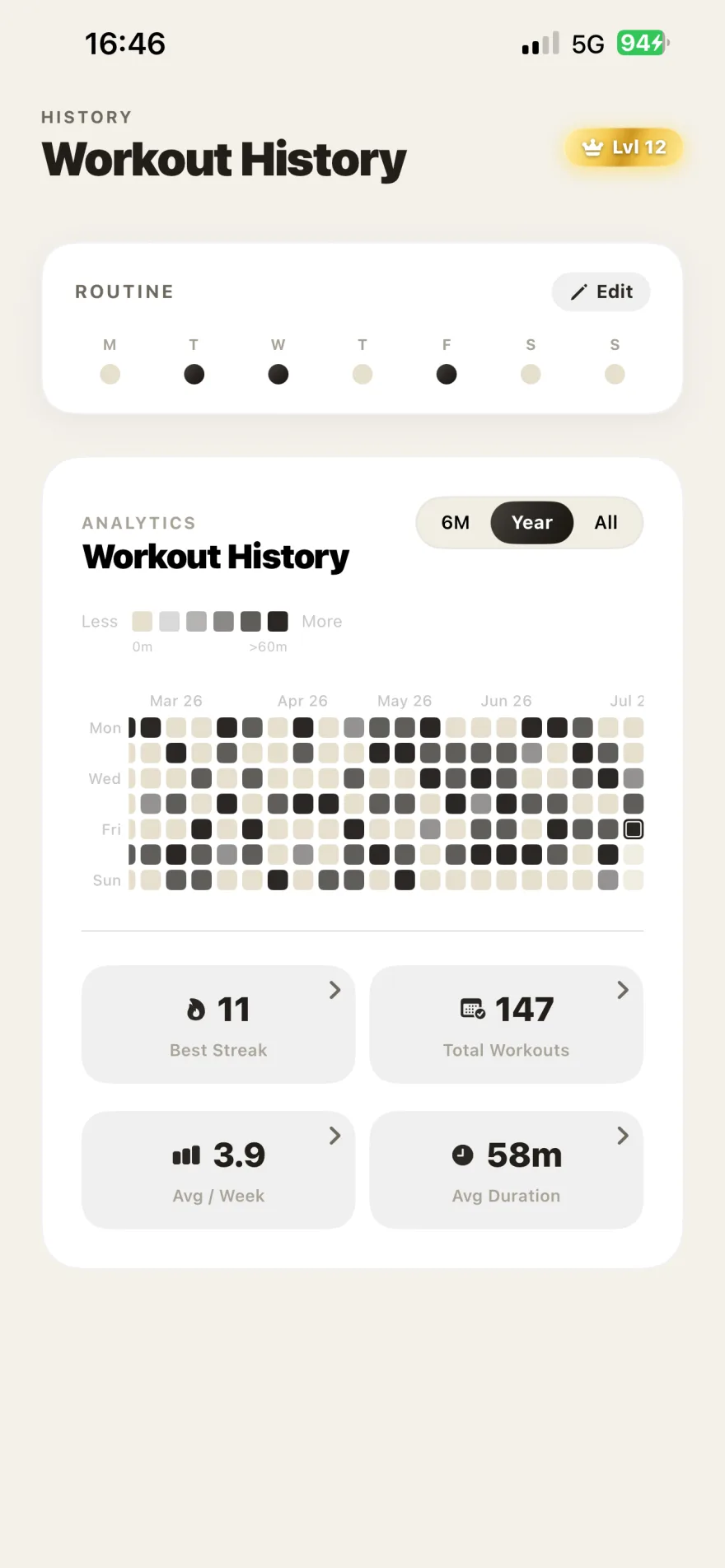
What you do with that number is where it gets interesting. If your average is 100 minutes and you dread going, you've found the thing to trim. If it's 40 minutes and you thought it was an hour, you just learned your habit is smaller and more repeatable than you believed, which is great news for consistency. GymRhythm puts the average next to your streaks, weekly goals counted in gym days, and a GitHub-style year heatmap, so session length sits inside the bigger picture of how often you actually show up.
One honest caveat. GymRhythm is an iPhone app, and it tracks visits, not exercises. It won't log your sets or weights, and it isn't trying to.
So, what's the average gym session length? Around 45 to 75 minutes for most people, with an hour as the crowd favorite. But the average is trivia. Your own number is a tool, and once it's measured instead of guessed, it tells you whether your routine is built to last.