 GymRhythm
The short answer: yes, going to the gym 3 times a week is enough for most goals
For most people, going to the gym 3 times a week is enough. Three full-body sessions per week can build muscle, increase strength, meet mainstream health guidelines, and support fat loss. The catch is the word every: three days every single week, not three days on motivated weeks and zero on busy ones.
That answer surprises people, because fitness content loves six-day splits and daily grind montages. But the person who trains three days a week for two years will look, feel, and perform better than the person who trains six days a week for six weeks and quits. It's not close.
The rest of this guide breaks down what three days actually delivers for each goal, when more genuinely helps, and the quiet problem that decides everything: most people can't say for sure whether they really hit three days last week.
What 3 days a week gets you: strength, health, body composition
Strength and muscle. Research on training frequency suggests that when total weekly work is similar, spreading it over three days builds strength and muscle about as well as spreading it over five or six. Frequency is a tool for distributing your training, not a magic ingredient on its own. For beginners and intermediates, three full-body sessions let you train every major muscle two to three times a week, which sits squarely in the range most evidence supports for growth.
General health. Mainstream guidelines from major health organizations call for roughly 150 minutes of moderate activity per week plus strength work on at least two days. Three gym sessions of 45 to 60 minutes clear both bars at once. If you're curious where your own sessions fall, we broke down average gym session length separately.
Body composition. Here's the honest version: fat loss is driven mostly by what you eat. Three training days a week do the job training is actually good at during a diet, which is protecting and building muscle so the weight you lose is fat. Adding a fourth or fifth gym day is a much weaker lever than fixing your plate.
| Goal | Is 3 days enough? | What matters most |
|---|---|---|
| Build muscle (beginner or intermediate) | Yes | Full-body sessions, progressive effort, showing up every week |
| General health and longevity | Yes, comfortably | Clears mainstream activity and strength guidelines |
| Fat loss | Yes, as the support act | Diet creates the deficit, training keeps the muscle |
| Advanced bodybuilding or strength | Often not | High weekly volume gets hard to fit into three sessions |
| Sport or endurance performance | Depends | Skill and conditioning work usually needs its own days |
Three consistent days beat six sporadic ones
Run the numbers over a year. Three days a week, never missed, is 156 sessions. A heroic six-day program that gets restarted three times and abandoned each time by week five adds up to far less. Your body adapts to what you do repeatedly, so the boring schedule wins.
Consistency also protects you from the real killer, which isn't a missed session but a missed month. One skipped week costs you almost nothing, and we covered what actually happens when you skip the gym for a week in detail. The danger is that week one quietly becomes week four. A fixed three-day rhythm makes that slide visible early, while a vague "I go when I can" schedule hides it until the habit is gone.
Three days is also the schedule that survives real life. It has recovery built in, and a missed Monday can slide to Tuesday without wrecking the week. A six-day plan has no slack, so one busy stretch breaks it.
Research on habit formation suggests new behaviors take around two months on average to feel automatic, with big individual differences. Anchoring your training to fixed weekdays, say Monday, Wednesday, and Friday, removes the daily negotiation about whether today is a gym day. If building that structure is the part you struggle with, start with our guide on how to be consistent with the gym.
When you'd want more than 3 days
There are real cases where three isn't the right number:
- Advanced lifters. After a few years of training, the weekly volume you need can get hard to squeeze into three sessions without each one running past 90 minutes.
- Sport and endurance goals. Runners, climbers, and fighters usually need conditioning and skill work on their own days, on top of strength training.
- Fast specialization. Chasing a specific lift or bringing up a lagging area can justify extra focused days for a stretch.
- You simply love it. If the gym is your hobby and your recovery keeps up, go more often. Enjoyment is a perfectly valid reason.
One rule though: earn day four. Add a day only after you've hit three days a week for a couple of months without drama. Scaling up a habit that already runs is easy. Scaling up a habit that doesn't exist yet is how January resolutions die.
And a note on tools, because it matters for what comes next. If your goals move toward detailed programming, you'll want an app that logs sets, reps, and weights. GymRhythm doesn't do that, and dedicated loggers like Hevy or Strong are the right tools for it. We compare them honestly in our guide to Hevy and Strong alternatives.
The real problem: did I actually do 3 this week?
Here's the part almost every article skips. Ask someone how many times they trained last week and you'll usually get a guess, not a number. Weeks blur together. Memory rounds up. A week with two visits feels like three because you thought hard about going a third time.
One subtlety that matters more than it sounds: count days, not sessions. If you went twice on Saturday, that's one training day. A three-day week spreads stimulus and recovery across the week, and cramming visits into a weekend doesn't replicate that.
You can verify your weeks manually. A paper calendar on the fridge works. So does a habit app where you tap a check-in after each session, and we compared the manual and automatic options in our gym habit tracker app guide. All of these work, and all of them share the same failure mode: they depend on you remembering to log, and logging is the first thing to go in exactly the busy weeks where the truth matters most.
Making your 3 days automatic to verify
This is exactly the problem GymRhythm was built for. You pin your gym on a map once and set a radius around it. From then on, your iPhone's geofencing notices when you arrive, and the app logs the visit with your arrival time and how long you stayed. No button to press, nothing to remember. You can pin multiple gyms if you split your training between locations.
Then you set a weekly goal of three gym days. The app counts days, not sessions, so a double visit on Saturday doesn't inflate your week. At any moment, the answer to "did I do three this week?" is sitting on the screen, measured instead of guessed.
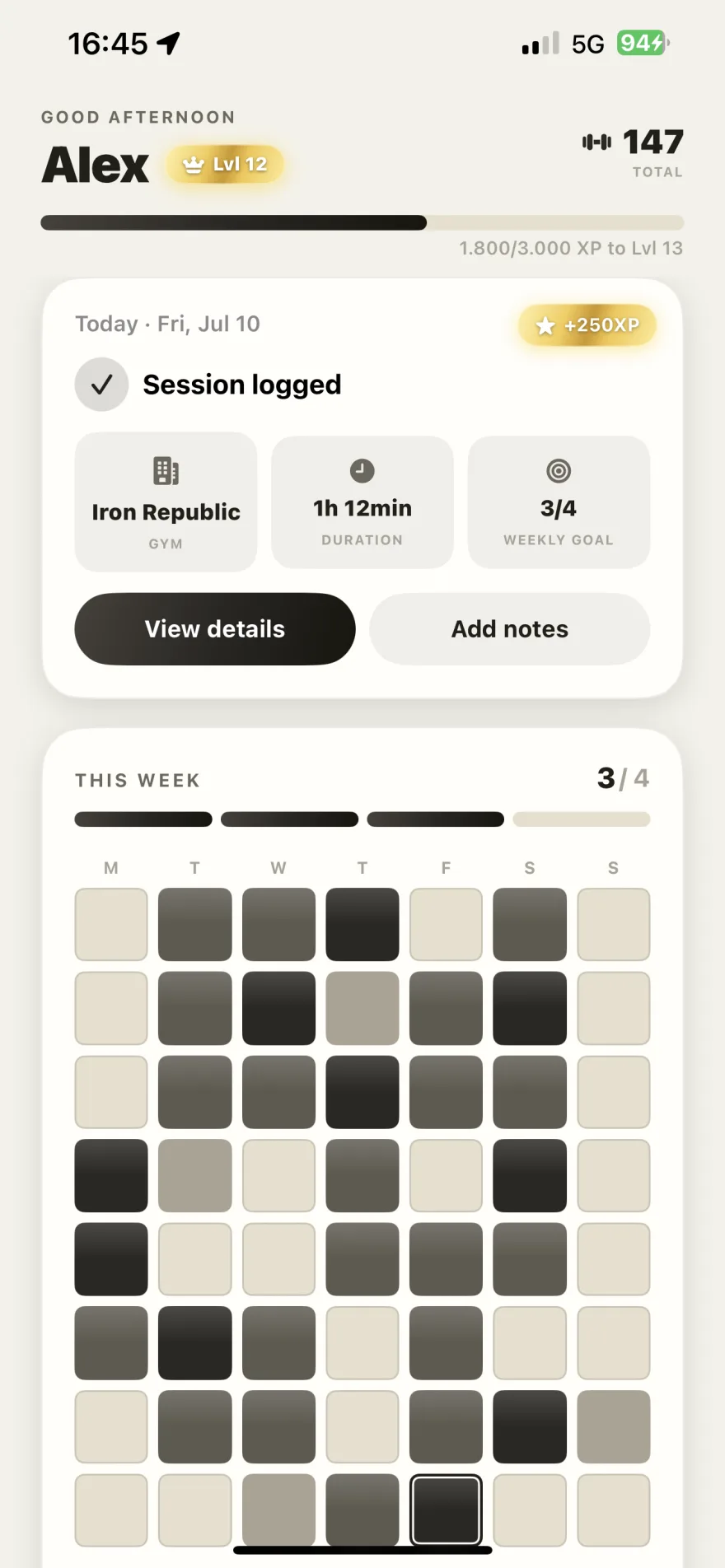
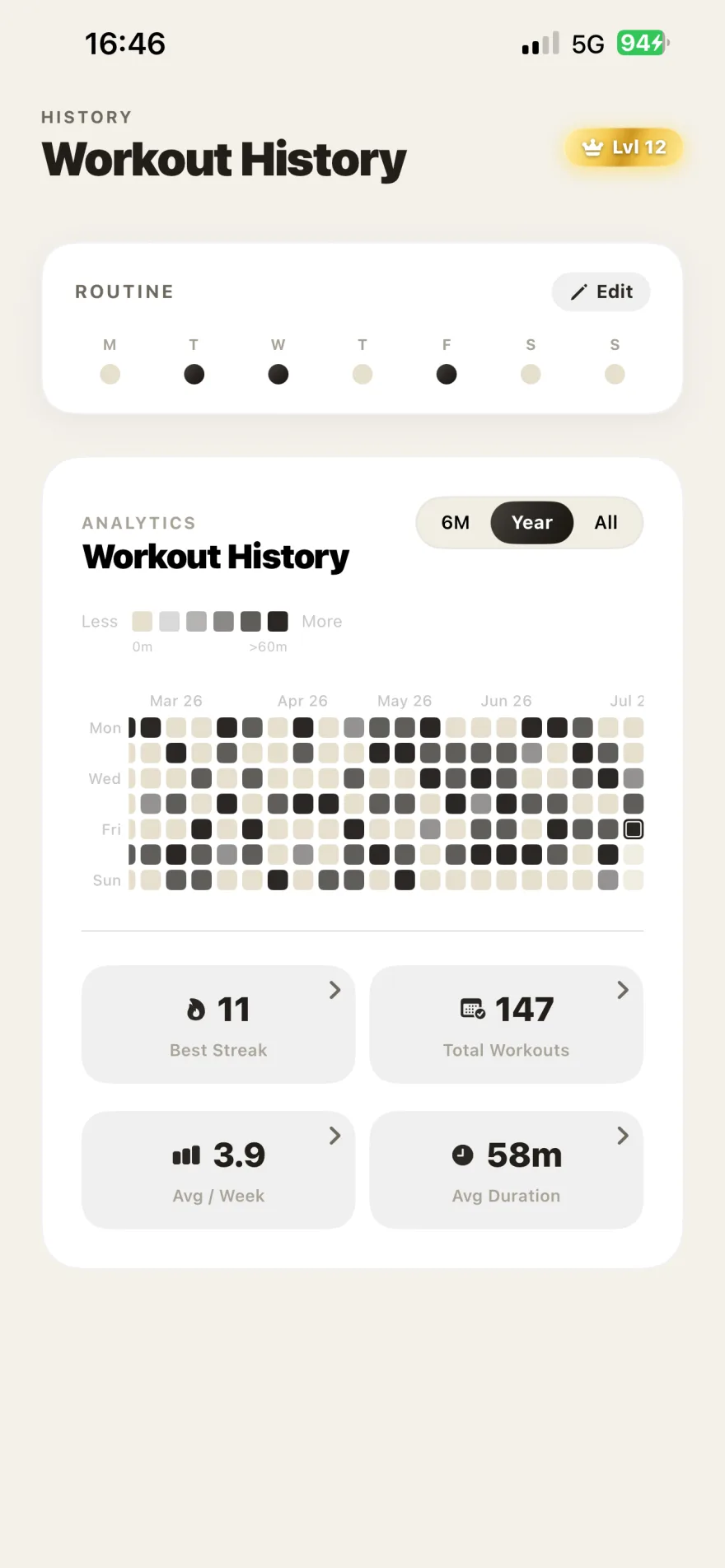
Over months, that record becomes the interesting part. You get streaks, a GitHub-style heatmap of your whole year, your average session time, and routine insights that show which weekdays you actually train versus which ones you think you train. There's a 50-level XP system with real unlocks like advanced analytics and dark mode, plus shareable stat cards for when a milestone deserves showing off.
Fair warning on scope: it's iPhone only and free to download, with a premium subscription for full access. It tracks attendance, not exercises. If automatic visit logging sounds like the missing piece, our guide to apps that track gym visits automatically covers how the approach works in depth.
So, is going to the gym 3 times a week enough? Yes, comfortably, for strength, health, and body composition. But "enough" only works if it actually happens. Pick your three days, protect them, and measure them, and the question answers itself week after week.