 GymRhythm
The short answer: skipping the gym for a week costs you almost nothing
Here is what happens if you skip the gym for a week: essentially nothing. Your strength is intact, your muscle tissue is still there, and research on detraining consistently suggests that measurable declines only begin somewhere around day 10 to 14 for most trained people. One week off is a pause, not a reset.
Your muscles might look a little flatter by day five or six. That is stored carbohydrate and water leaving the muscle, not tissue disappearing, and it refills within a few normal sessions. Plenty of lifters actually come back from a week off feeling stronger, because the fatigue that built up over weeks of training finally cleared. Coaches program deliberate rest weeks, called deloads, for exactly this reason.
So if you just had a sick week, a travel week, or a week where life simply fell apart, the physical cost is close to zero. The honest concern is not your muscles. It is what the second week does to your habit, and that part deserves real attention.
The real detraining timeline (day 10 to 14 and beyond)
Detraining is not a cliff. It is a slow slope that starts later than most people fear. The exact timing depends on how long you have been training, how you eat and sleep during the break, and how active you stay, but the broad pattern in the research is fairly consistent.
| Time away | What actually happens |
|---|---|
| Days 1 to 7 | No meaningful loss. Fatigue clears, muscles can look flatter from lower glycogen and water, strength holds. |
| Days 8 to 14 | Cardio fitness dips first. Strength stays largely stable, though the first session back may feel rusty. |
| Weeks 3 to 4 | Strength begins a slow decline, and studies start to find small measurable drops in muscle size. |
| Month 2 and beyond | Losses become noticeable in the gym, but they come back far faster than they were originally built. |
Two details make this timeline even friendlier. First, endurance fades faster than strength, so if you mostly lift, you keep more than a runner would over the same gap. Second, muscle memory is real. Research on retraining suggests that people regain lost muscle and strength in a fraction of the time it took to build them, partly because muscle cells appear to hold on to some of their adaptations even while shrinking.
In other words, even the worst case here is recoverable. A month off sets you back weeks, not years. A single week sets you back nothing at all.
The actual risk: one week quietly becoming a month
Here is the part that actually deserves your anxiety. Nobody quits the gym on purpose. Nobody wakes up and announces they are done. What happens instead is that a legitimately missed week (flu, deadlines, a holiday) rolls into a second week because the streak feels broken anyway. By the third week you stop thinking about it. By week six you would describe yourself as someone who used to go to the gym.
Habit research backs up half of that story and softens the other half. One well-known study on habit formation found that missing a single opportunity did not measurably damage long-term habit strength. Habits survive single misses. What kills them is the meaning we attach to the miss, the "I have already failed" story that makes the second and third miss feel inevitable.
So the stakes of a skipped week are real, but they are not physiological. They are narrative. The question is never whether you lost muscle in seven days. You did not. The question is whether next week looks like a normal training week or like week two of a quiet quit.
The never-miss-twice rule for weeks
James Clear popularized a simple recovery rule for daily habits: never miss twice. One miss is an accident. Two misses is the start of a new habit. For the gym, where almost nobody trains daily anyway, the useful version applies to weeks. One zero week can happen to anyone. Two zero weeks in a row is a decision.
Making that rule work takes almost nothing:
- Book the first session early. Get to the gym on Monday or Tuesday of the comeback week. The longer the first visit drifts, the more the week fills up around it.
- Lower the bar on purpose. The comeback session only has to happen. Thirty easy minutes count in full. You are voting for your identity, not chasing a performance.
- Count days, not workouts. A weekly goal measured in gym days, like three days a week, is concrete and hard to argue with. You were either there or you were not.
This is one small piece of a bigger system. If you want the full picture of how consistent people structure their training weeks, read our guide on how to be consistent with the gym.
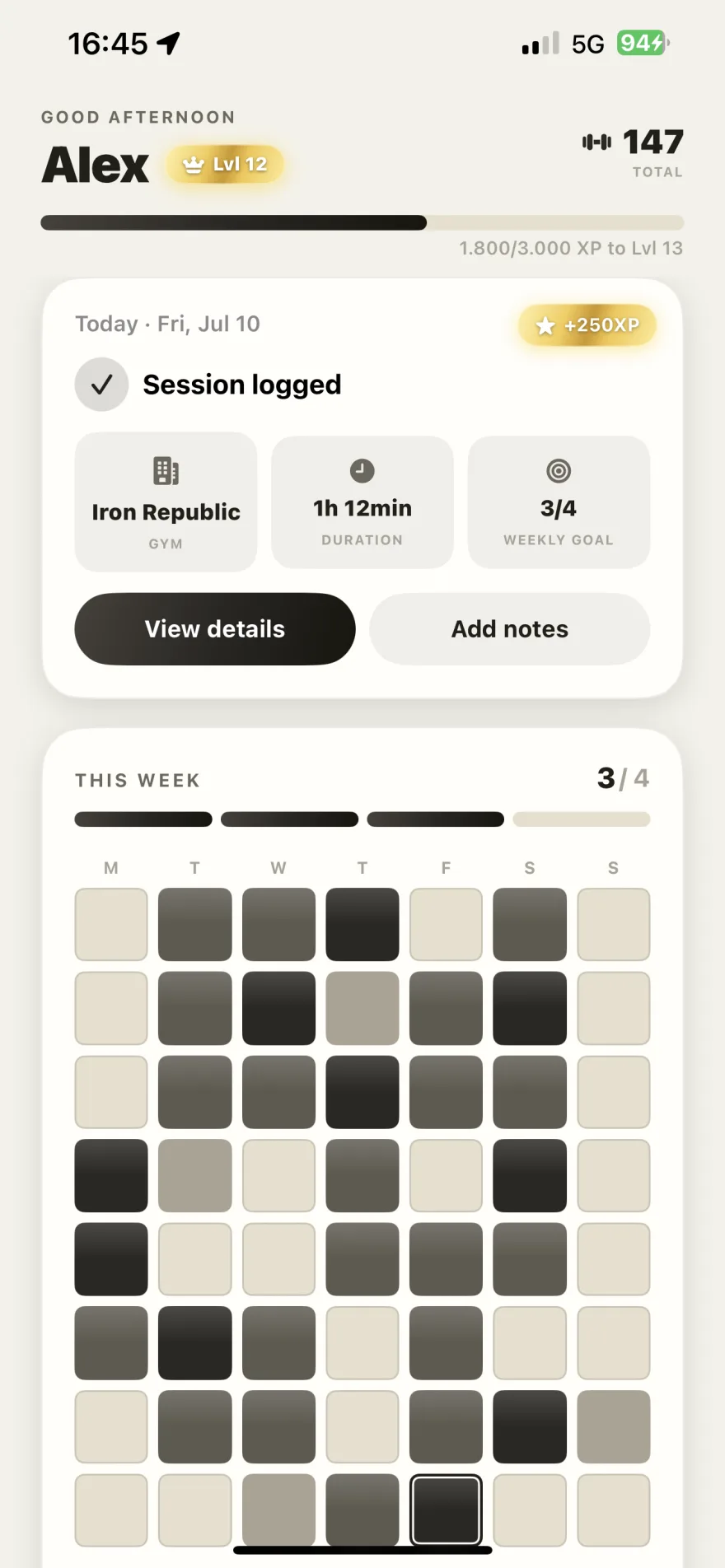
A weekly goal has one underrated property for exactly this situation: it resets. Last week's zero does not follow you around. On Monday morning the counter reads zero out of three for everyone, including the person who never missed. That fresh start is not a loophole. It is the mechanism that keeps one bad week contained.
Restarting without guilt
The first session back is where most comebacks die, usually from one of two mistakes. The first is punishment training, trying to make up for the missed week with a monster session. You will be sore for four days and dread the next visit. The second is waiting until you feel ready, which is a date that never arrives on its own.
The boring middle path works:
- Do your normal routine, whatever you were doing before the break.
- Take roughly ten percent off your usual weights or effort. After only a week you probably do not need to, but it makes the session feel easy, and easy sessions get repeated.
- Show up again within two or three days. By the second or third visit you will be at full strength and the gap will be invisible in your performance.
If you were training five days a week before the break, consider restarting at three. Three consistent days beat five aspirational ones, and for most goals three is genuinely enough. We dug into that in is going to the gym 3 times a week enough.
And drop the guilt entirely. Nobody at the gym noticed you were gone. Your body barely noticed. The only thing keeping score is the story you tell yourself, so make that story accurate instead of dramatic.
Making the gap visible so it can't grow
The difference between a break and a quit is noticing. "It has been a while" is how memory works, and it is dangerously vague. It feels the same at day 9 and at day 35. If the gap is invisible, it grows. If the gap is visible, it nudges you at exactly the right moment, around day ten, while the comeback is still trivial.
This is why a visual attendance record beats any amount of willpower. On a GitHub-style year heatmap, a skipped week is one pale row surrounded by months of filled squares. Seen that way, it is obviously a blip, not an identity change. And it cannot quietly become four pale rows without you watching it happen. If that picture appeals to you, we wrote a whole piece on GitHub-style fitness trackers.
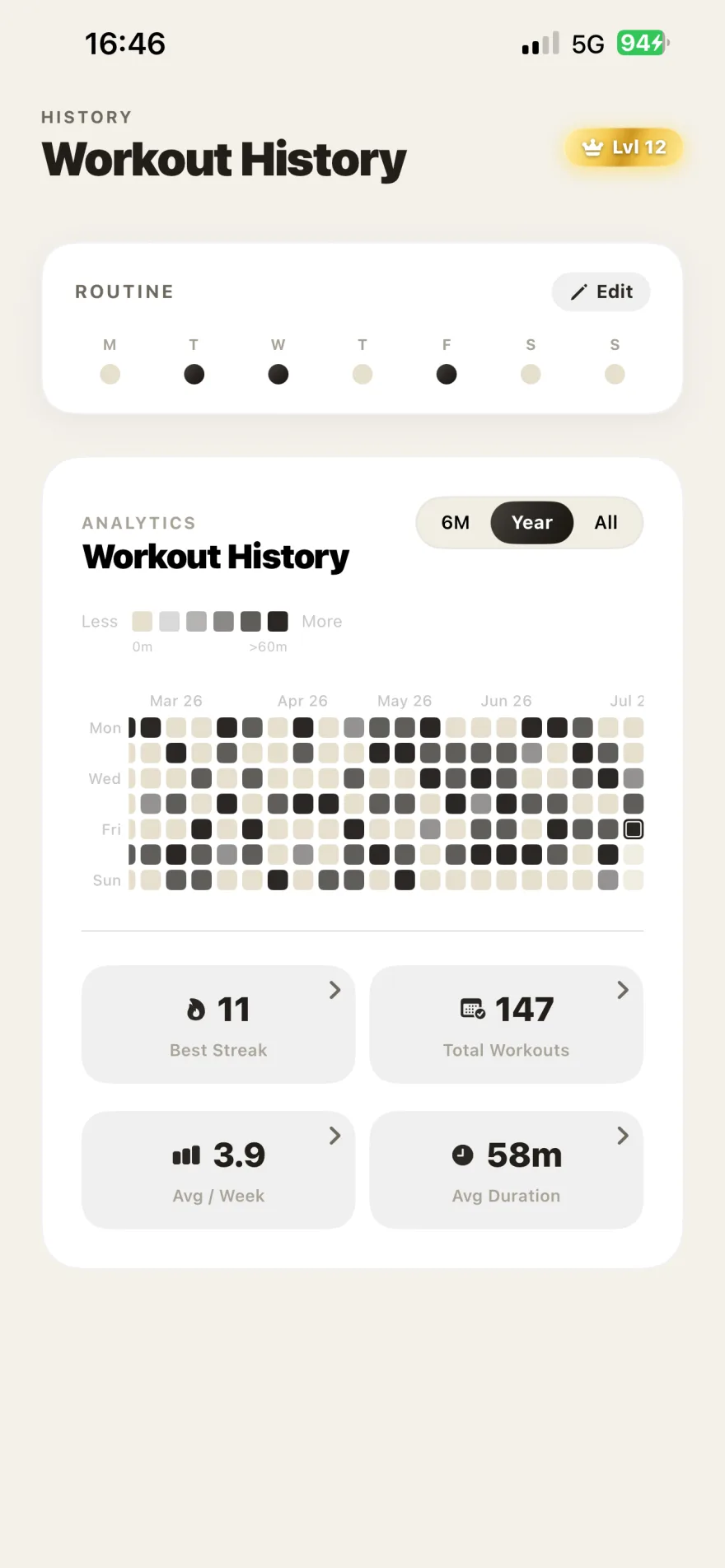
The catch with most tracking is that manual logging fails exactly when you need it most. The week your motivation dips is the week you stop opening the logging app, so the record dies together with the habit. That is the problem GymRhythm was built around. You pin your gym on a map once, and Apple's geofencing logs every visit automatically with arrival time and duration. The heatmap fills itself, the weekly goal counts your gym days, and a 50-level XP system gives the comeback a little extra pull. If you want to compare that approach with manual check-in apps, see our breakdown of gym habit tracker apps.
One honest caveat. GymRhythm tracks attendance, not training content. If your worry after a week off is about your program, your working weights, or picking up your log where you left it, a rep logger like Hevy or Strong is the right tool for that job, and we compare them honestly in do you need another workout logger. Plenty of people run both, one for what happens inside the session and one for whether the sessions keep happening.
So, what happens if you skip the gym for a week? Physically, nothing worth a minute of guilt. What matters is entirely in your hands over the next seven days: one unremarkable session, booked early, at comfortable weights. Do that, and the skipped week becomes what it always should have been, a rest week with a bad reputation.