 GymRhythm
If you're searching for how to be consistent at the gym with ADHD, here's the honest answer up front: stop trying to fix your discipline and start removing the need for it. Consistency comes from a system with three parts. Cut friction until getting out the door barely requires a decision, make progress visible enough that your brain actually feels it, and hand the scorekeeping to something that can't forget. This guide walks through each part, plus the one step where almost every classic tip quietly falls apart.
Why "just be disciplined" fails the ADHD brain
ADHD isn't a knowledge problem or a character problem. It's a difference in executive function, the mental machinery that handles planning, starting unappealing tasks, and holding an intention in mind long enough to act on it. Telling someone with ADHD to be more disciplined is like telling someone with bad eyesight to squint harder. The advice prescribes more of the exact resource that's in short supply.
There's a second piece. ADHD motivation tends to run on interest, novelty, urgency, and immediate reward rather than on importance. The gym is important but almost never urgent, and its real rewards arrive months later. You can genuinely want to train and still find yourself at 9pm realizing you never went, because your brain knew it mattered but couldn't feel that it mattered today.
Add time blindness and out of sight, out of mind, and the pattern makes sense. You didn't fall off because you're lazy. You fell off because the plan lived in your working memory, and working memory is exactly where ADHD plans go to die. So every strategy that follows has one job: move the plan out of your head and into the world.
Cut every gram of friction between you and the door
For an ADHD brain, every decision between "I should go" and "I'm walking in" is a place to lose the thread. Remove the decisions.
- Pick the closest gym, not the best gym. A mediocre gym eight minutes away beats a great one twenty-five minutes away, because the trip is friction you pay on every single visit.
- Pack the bag the night before and leave it in front of the door. Training in the morning? Lay out the clothes or sleep in them. Zero-shame tactics are allowed here.
- Anchor the gym to something that already happens. "After my last lecture on Monday, Wednesday, and Friday, I walk to the gym" beats "I'll go three times this week," because the trigger is an event, not a memory.
- Same days, same time. Save the novelty for what you do inside the gym. The skeleton of the habit should be boring enough for a calendar to enforce.
- Use the ten-minute rule. Your only job is to arrive and do ten minutes, and you're allowed to leave after that. You almost never will, but the tiny commitment gets you past the starting wall.
Notice what's missing: nothing here asks you to feel motivated. Research on habit formation suggests new routines take around two months of repetition to start feeling automatic, often longer, so your system has to survive weeks where motivation sits at zero.
Body-doubling and other external structure
Body doubling, doing a task while another person is present, is one of the most reliably helpful ADHD strategies, and it maps neatly onto the gym.
- A standing gym partner. Someone expecting you at 6pm converts "I should go" into "someone is waiting." Urgency is fuel the ADHD brain actually runs on.
- Booked classes. A fixed start time, a reserved spot, and often a late-cancellation fee. That's three external structures in one purchase.
- A trainer, if budget allows. A paid appointment is the strongest external accountability money can buy.
- Virtual body doubling. Services like Focusmate popularized working alongside a stranger on video for desk tasks, and some people adapt the idea to home training. For the gym itself, even a "leaving now" text to a friend who expects it can be enough.
The theme is simple. Don't rely on internal accountability you don't reliably have. Borrow someone else's.
Dopamine-friendly progress you can see
Here's the cruel joke of fitness with ADHD. The real rewards, strength, energy, body composition, arrive on a delay of months, and delayed rewards are precisely what the ADHD brain discounts. If the only payoff is invisible, your brain files the gym under "no reward" and stops initiating.
The workaround is to manufacture an immediate, visible reward: a scoreboard that updates the same day you show up.
The classic version is the Seinfeld method. Hang a calendar, mark an X on every gym day, and don't break the chain. The modern version is the GitHub-style contribution graph, a grid of the whole year where every visit becomes a colored square. If you've ever felt the pull of keeping a green streak alive, you know how well this works on a novelty-seeking brain. There's a whole guide on GitHub-style fitness tracking if that idea hooks you.
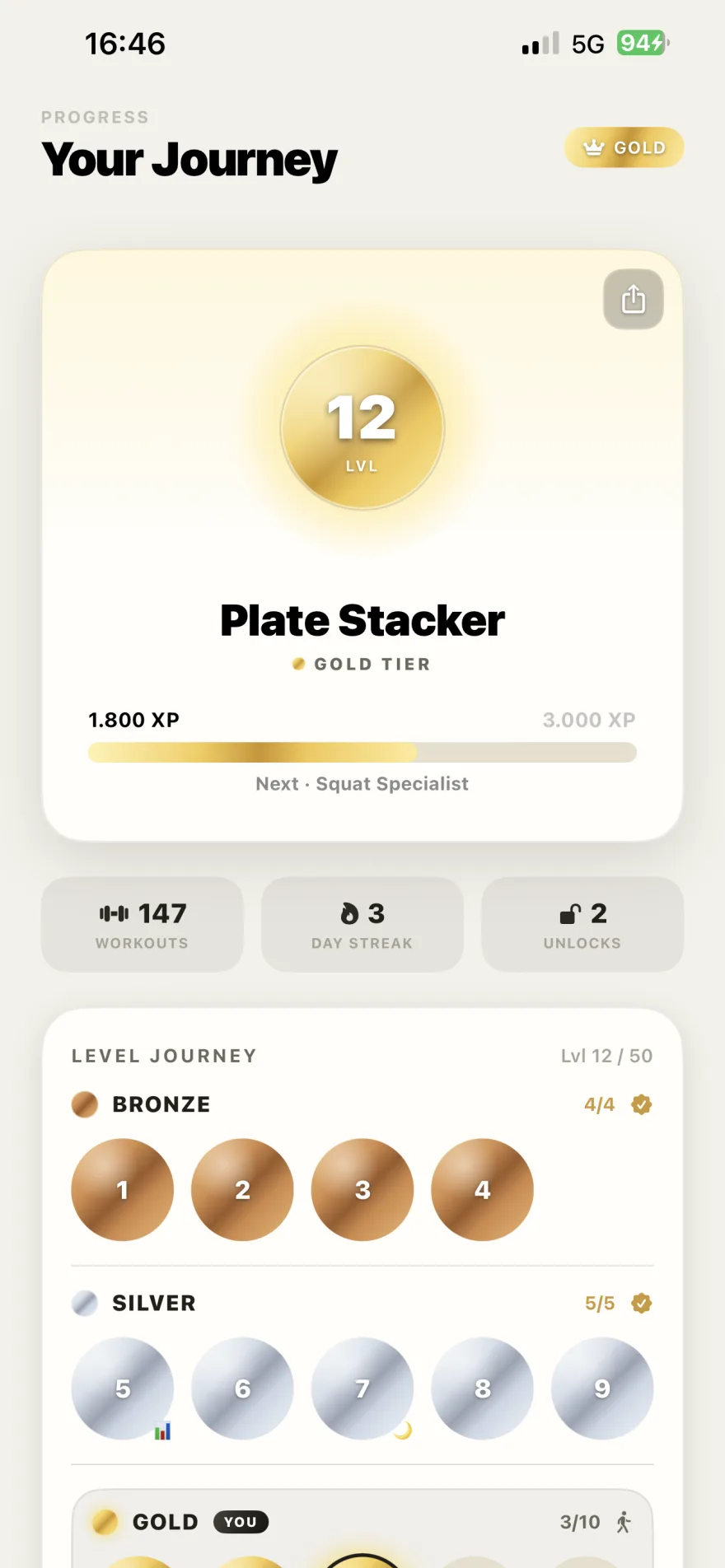
Gamification stacks on top. Points, levels, and unlocks sound gimmicky until you remember that ADHD motivation responds to exactly those things. A visit that earns XP toward your next level feels different from a visit that earns a vague future benefit.
Self-compassion on missed days (the two-miss cliff)
You will miss days. That's not pessimism, it's arithmetic over a long enough timeline, and with ADHD the odds go up. What decides whether you're consistent isn't whether you miss. It's what happens next.
ADHD often comes bundled with all-or-nothing thinking and a hair-trigger shame response. One missed session becomes "I broke it," which becomes "I always do this," which becomes three weeks off. The miss didn't kill the habit. The story you told yourself about the miss did.
- Never miss twice. One skipped day is noise. Two in a row is the start of a new pattern. The only truly non-negotiable session is the one right after a miss, even if it's a token ten minutes.
- Count your week in days, not perfection. A goal of "three gym days this week" absorbs a bad Tuesday without collapsing. A goal of "every day or I've failed" hands the shame spiral a loaded weapon.
And for perspective, a single week off costs you almost nothing physically. The real detraining timeline is covered in what actually happens when you skip the gym for a week.
Why manual habit trackers fail at the "remember to log" step
Everything above is solid, standard advice: reduce friction, borrow structure, make progress visible, forgive the misses. But almost every version of "make progress visible" hides the same trap.
Mark the X on the calendar. Tick the box in the habit app. Log the visit. Every one of those depends on prospective memory, remembering to do a small thing at the right future moment. For ADHD that's not a small ask. It's the single most taxed function you have. You did the hard part, you actually trained, and the calendar stayed blank anyway because the marker was in the other room.
Then the damage compounds. A streak with phantom gaps stops being true, and once the record lies, it stops producing the dopamine hit that was its entire purpose. The tracker becomes one more abandoned app. If you've been through that loop, it wasn't a you problem. It was a tooling problem.
| Tracking method | What you must remember | When you forget |
|---|---|---|
| Paper calendar | Mark an X after every visit | A false gap appears and the streak lies |
| Manual habit app | Open the app, tap the habit | Same false gap, plus guilt-trip reminders |
| Automatic attendance tracking | Nothing after a one-time setup | Nothing to forget, the record stays true |
To be fair to manual tools: if your goal is logging sets, reps, and weights, manual entry is unavoidable and worth it, and dedicated loggers like Hevy or Strong are excellent at exactly that. That category gets a fair look in our guide to Hevy and Strong alternatives. But if the thing you're fighting for is attendance, logging is optional admin, and optional admin is where ADHD systems go to die. There's a fuller comparison in our roundup of gym habit tracker apps.
Automating the scorekeeping: staying consistent at the gym with ADHD
The principle: choose a scoreboard that needs zero prospective memory. Some gym chains get partway there, since their member apps record your check-ins, but the history is usually buried and nothing motivating is built on top of it.
That gap is exactly what GymRhythm was built for. You pin your gym on a map once, set a radius, and Apple's geofencing does the rest. Walk in and the session logs itself, with your arrival time and how long you stayed. You can pin multiple gyms if you split locations.
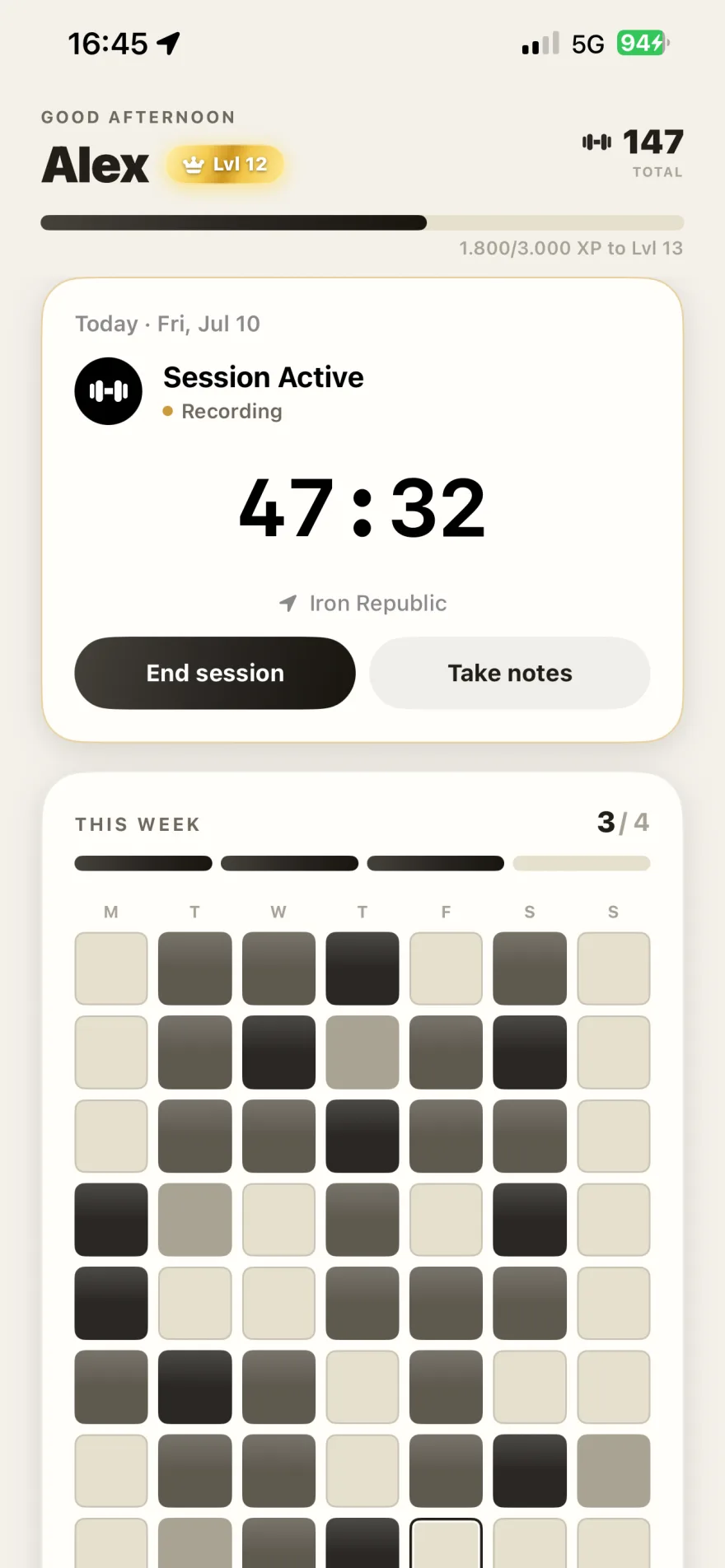
On top of that automatic record sit the dopamine layers this whole article has been arguing for: streaks, a weekly goal measured in gym days per week (so it matches the count-in-days rule above), a GitHub-style year heatmap, your average session time, routine insights that show which days you actually train, and a 50-level XP system where levels unlock real features like advanced analytics and dark mode. Hit a milestone and you can share a stat card.
Just as important is what it deliberately doesn't do: no sets, reps, weights, or workout plans. It tracks one thing, whether you showed up, because for an ADHD brain that's the metric that decides everything else. It's iPhone-only and free to download, with a premium subscription for full access. There's more detail in our guide to apps that track gym visits automatically.
So that's how to be consistent at the gym with ADHD. Not more discipline. A short trip, a packed bag, a person or a class expecting you, a scoreboard that pays out the same day, a never-miss-twice rule for the bad weeks, and scorekeeping that runs without your memory. Build that system once, and the version of you having a scattered, low-dopamine Thursday still ends up walking through the gym door.